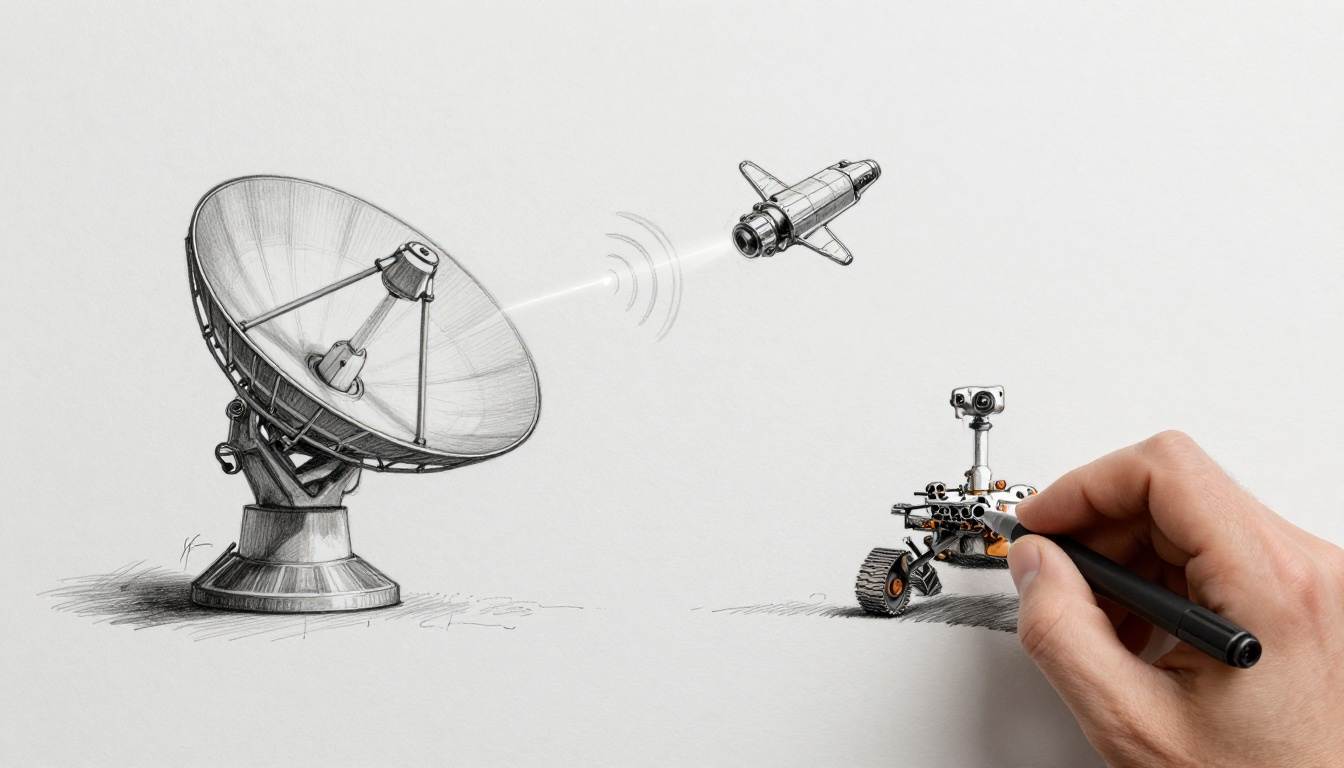
A rover on Mars can “hear” your command minutes after you send it. That’s not magic, it’s physics and smart engineering. Signals travel between Earth and space by using radio waves (and, increasingly, lasers) to carry information across huge distances.
If you’ve ever wondered how a spacecraft gets your message, or how it sends data back, the answer starts with something simple: waves that move at the speed of light. Then you add antennas, frequencies, timing, and careful decoding.
Below, you’ll see the full path from Earth to space and back. You’ll also learn why the signals get weaker, how teams catch faint replies, and what’s coming next.
Breaking Down Uplink and Downlink: Earth Sends, Space Replies
Think of space communication like a two-way walkie-talkie, except the “walkie” is millions of miles apart. To make it work, missions use two directions:
- Uplink: Earth sends commands to a spacecraft
- Downlink: the spacecraft sends data back to Earth
Most missions rely on electromagnetic waves. These waves include radio signals, which can travel through the vacuum of space. In simple terms, the signal doesn’t need air. It just needs the right transmitter, the right carrier frequency, and a receiver that can pull the information out of the noise.
The speed part matters too. Radio waves move at light speed. Still, distance adds delay. That delay sets expectations for every reply. For Mars, round-trip time can be tens of minutes. For far targets, it can be hours or days.
Earth’s sending gear is designed to put out strong power. Then Earth’s receiving gear is designed to do the opposite: detect extremely weak signals and recover bits from them. This is why ground networks matter.
One major player is NASA’s Deep Space Network (DSN), with big antennas on multiple continents. NASA explains where these DSN complexes operate here: Where is the DSN Located?. Having stations spaced around the globe helps keep coverage as Earth rotates.
Here’s a quick mental picture. When you tell a Mars rover to capture an image, Earth encodes that request into a stream of digital bits. It then beams that stream upward. The rover receives the uplink, checks it for errors, runs its plan, and stores the photo.
After that, the rover sends the photo back. The downlink might be faint at Earth. Yet DSN antennas and receivers are built to amplify and decode it.
The big idea: uplink sends the “do this”, and downlink sends the “here’s what happened.”
Why Uplink Needs Monster Power from Earth
An uplink has to cross a lot of distance and arrive cleanly. Spacecraft receivers can only handle so much. They also have strict limits on size, mass, and power. So Earth often does the heavy lifting.
Uplink transmitters send strong signals toward the target. Ground stations use large dish antennas to squeeze the wave into a narrow beam. That beam spreads out as it travels, so the signal weakens with distance.
A helpful analogy is yelling across a field. Your voice gets quieter as the other person gets farther away. In space, the drop is even more dramatic. Signal strength falls with distance in a way often summarized by the inverse square idea (double the distance, and the signal gets much weaker).
Missions also encode commands into digital data. They turn instructions into 0s and 1s, then modulate a carrier wave to represent those bits. The spacecraft can’t read the “picture” of the wave. Instead, it measures changes in the signal and reconstructs the bits.
Near Earth, many missions use S-band because it works well for typical spacecraft links. For deeper space, other bands may help too, but the key point stays the same: uplink needs enough power for the spacecraft to lock onto the signal.
Downlink’s Tricky Weak Signals and How We Catch Them
Downlink is where things get hard. The spacecraft often has less power than Earth. It may also have a smaller antenna. So the return signal is usually far weaker.
For deep-space missions, teams often measure how weak the downlink is in relative terms. Voyager signals, for example, were once described as incredibly faint by Earth standards, even after decades of travel. The exact “how many times weaker” depends on when and how you measure it, but the theme is constant: the downlink is a whisper.
So how do receivers hear a whisper?
First, ground antennas collect the tiny signal. Then receivers amplify it. After that, software helps lock the timing and carrier. Finally, the system decodes the bits and checks for errors.
Downlink also takes time. For Mars, a typical one-way delay can land around several minutes. Depending on the planet’s positions, delays can be roughly 4 to 24 minutes one way. That’s why rover commands include schedules and safety rules. Earth can’t “fix mistakes” instantly.
Another big challenge is that space links compete with background noise. That noise can come from the receiver itself, from cosmic sources, and from interference. Engineers reduce the noise and increase the signal quality through:
- careful frequency choice
- narrow beam antennas
- robust error correction
- steady tracking as the craft moves
The Gear and Frequencies Powering Space Signals
If uplink and downlink are the two roads, frequencies are the lanes. A spacecraft can’t just shout on any channel. It needs a known carrier frequency and an agreed modulation method.
Different parts of the spectrum behave differently in Earth’s atmosphere. Some bands handle rain and clouds better. Some carry more data. Others help with long-range reliability.
NASA’s basics on spaceflight and electromagnetic behavior can help explain why radio waves work and how different parts of the spectrum behave. Start with: Basics of spaceflight electromagnetic signals.
Then you connect that to real mission choices.
S-band, X-band, Ka-band: Picking the Perfect Frequency
Here’s a simple way to compare the common bands you’ll hear about.
| Band | Typical use | What it’s good at | Common tradeoff |
|---|---|---|---|
| S-band (2 to 4 GHz) | Near-Earth links, ISS support | Strong link margin, good reliability | Less raw data speed |
| X-band (8 to 12 GHz) | Deep-space missions | Good balance for long distance | Higher losses than S-band |
| Ka-band (26 to 40 GHz) | High-data links | Higher possible data rates | More sensitive to weather |
You’ll often see S-band for tasks like routine telemetry and voice. It’s popular when you want a stable connection.
X-band shows up in many Mars and deep-space systems. It can support high-quality science return. Also, it has a long history of successful deep-space operations.
Ka-band pushes for more data. As missions chase higher resolution images, faster science data, and richer video, Ka-band becomes attractive. But it can face more “weather fade” when signals pass through rain.
Frequency choice is a promise. Pick the band wrong, and your message may not arrive when you need it.
A concrete example: NASA discusses Ka-band as a future-oriented option for space communications here: Ka-Band Represents the Future of Space Communications.
Antennas and Modulation: Aiming and Packing Data
Antennas do two jobs: collecting power and aiming the beam.
On Earth, DSN dishes can be huge. On spacecraft, antennas are smaller and lighter. So missions rely on precise pointing. As a spacecraft orbits, Earth’s ground station must track it, and the spacecraft must track its expected direction too.
Modulation is the second job. It’s how the system “writes” information onto the carrier wave.
A simple mental model is like digital Morse code. Morse code isn’t just sound. It’s patterns over time. Similarly, modulation turns the data into changes in a radio wave.
Engineers may vary:
- frequency (how fast the carrier shifts)
- amplitude (how strong the signal is)
- phase (how the wave aligns in time)
Some systems use schemes that combine these ideas. Still, the purpose stays clear. The spacecraft and Earth must use matching methods so the receiver can translate the wave back into bits.
Meanwhile, the spacecraft’s antenna design has to survive launch and operate with limited power. That’s why many missions pick modulation methods that balance data rate with the receiver’s ability to decode weak signals.
Signals in Action: From ISS to Mars Rovers and Beyond
Theory helps, but what does it look like in the real world? It looks like constant tracking, relay support, and careful scheduling around delays.
Because missions move and Earth rotates, the signal path rarely stays “one direct line” all the time. Instead, teams build a network around the craft.
Daily Chats with ISS Astronauts
Low Earth orbit links feel faster, partly because the distance is smaller. But the ISS still needs support as it moves around the planet.
The ISS can communicate using relay satellites. One well-known system is NASA’s Tracking and Data Relay Satellite (TDRS) network. NASA describes TDRS generations and how it supports missions here: Tracking and Data Relay Satellites (TDRS).
With relay coverage, the ISS can maintain closer to continuous contact than it could with ground passes alone. Ground teams still monitor telemetry. They also send commands and handle data downlinks.
For daily chats, voice and basic telemetry don’t require the extreme weak-signal tricks needed for far targets. Still, the system needs fast handling and reliable timing.
Rovers on Mars Beaming Back Stunning Photos
Mars rover communications follow the uplink and downlink pattern, but with extra steps.
Earth sends commands, usually through a deep-space link using X-band or similar choices. The rover receives the command, then it acts locally. After that, the rover sends the results back.
Because direct Earth to rover time is slow, Mars often uses orbiters as relays. Orbiters can “stand between” Earth and the rover. That can improve the chance of timely downlink windows.
Then there’s the delay. If you want a photo, you might send a command and wait. The rover can’t run a quick retry if something goes wrong. It has to plan ahead.
That’s why rover operations rely on carefully tested communication modes. It’s also why the data formats include error checks and robust coding.
Starlink’s Global Internet from Orbit
Not all space signals are for science missions. Some are for everyday internet.
As of March 2026, Starlink has over 10,020 satellites in its constellation. It uses Ka-band for communication. One analysis also notes that Starlink makes up about 65% of active satellites worldwide.
Ka-band helps because it can support higher data rates. For users, the system also aims for low latency, often described around the 25 to 35 ms range, depending on location and network conditions.
The “handoff” part matters. Satellites pass coverage between each other and ground gateways. So your phone or laptop gets a steady link, even as satellites move overhead.
In short, Starlink shows what happens when space signals scale up into a global service. The physics stays the same, but the network design gets much more complex.
Overcoming Huge Hurdles Like Distance and Weather
Space communication faces three big enemies: distance, atmosphere, and alignment.
Distance weakens signals. That makes downlink decoding harder. Atmosphere can absorb or scatter higher frequencies. And pointing must stay accurate, even while the craft and Earth move.
Battling Signal Fade Over Billions of Miles
As distance grows, the signal spreads out. The receiver sees less power per unit area. That can make the signal sink into noise.
This is where big antennas, low-noise electronics, and careful coding show up. DSN doesn’t just have dishes. It also has receiver systems designed to pull out faint data.
Also, missions pick link budgets with realistic assumptions. Engineers plan for “best case” and “worst case.” If the weather or space conditions shift, the system should still hold.
One more trick is using tracking and calibration. Ground systems estimate the craft’s motion and adjust the received signal timing. That prevents the bits from “drifting” during long sessions.
Weather and Atmosphere Throwing Curveballs
Atmosphere is the most famous limitation on Earth side links.
Higher frequencies, like Ka-band, can be more sensitive to rain and clouds. This is sometimes called rain fade. When the air absorbs energy, the signal can lose strength.
The ionosphere also affects radio waves. It can bend or delay them. That’s especially noticeable for some frequencies and during certain solar conditions.
Meanwhile, the spacecraft uses its own systems to correct for timing and Doppler shifts. Doppler is the frequency change from relative motion. As the spacecraft approaches and moves away, the received frequency shifts slightly. Ground processing accounts for that.
Here’s a key trade: if you want more data, you often pick a band that can carry it. Then you improve ground weather models, scheduling, and backup modes so the link stays stable.
Weather and distance fight each other. A plan that accounts for both beats a plan that hopes for clear skies.
Future Breakthroughs: Lasers and Quantum Coming Soon
Radio still dominates space links today. Still, new tech keeps pushing toward faster and more reliable communication.
Two big directions stand out: optical links (lasers) and quantum security.
Laser Comms: Superfast Upgrade to Radio Waves
NASA’s Deep Space Optical Communications (DSOC) experiment on the Psyche spacecraft tested laser links in deep space. According to recent mission status, DSOC officially concluded in September 2025, after meeting its goals.
During testing, it received data from Psyche at distances that reached 307 million miles. The system also accumulated 13.6 terabits of data. NASA reported results that showed the laser method could be 10 to 100 times faster than traditional radio links for spacecraft communication.
Lasers help because they can carry more data through tighter beams. They also create less “wide spreading” than radio, so you can pack more information.
Yet they also require precision. Lasers need accurate pointing and stable tracking. Dust, jitter, and thermal shifts can matter. Still, the DSOC results suggest the approach is more than a lab demo.
In the near term, laser links may expand for missions that need higher science data rates without huge antenna upgrades.
Quantum and secure links (where it stands)
Quantum key distribution has moved beyond theory in parts of the space world. Satellites like China’s Micius have supported key distribution tests over long distances.
In practice, it’s not yet a common daily service for missions. Still, the direction is clear: researchers want ways to detect eavesdropping, and to make key exchange harder to tamper with.
For everyday readers, the takeaway is simple. Communication isn’t only about speed. It’s also about trust.
Conclusion
Signals travel between Earth and space using radio waves and, more and more, laser beams. Earth sends commands through uplinks, and spacecraft send science back through downlinks.
The process depends on frequency choices, antenna size, modulation methods, and error correction. Distance and weather keep pushing engineers to improve tracking and receiver sensitivity.
And when you look at what’s working now, it’s hard not to feel amazed. From ISS relay chats to Mars photo returns and laser link tests on Psyche, human teams keep building bridges across light minutes.
What mission’s communication system do you find most interesting, the ISS, Mars rovers, or something farther out? Share your pick, and subscribe for more space updates.