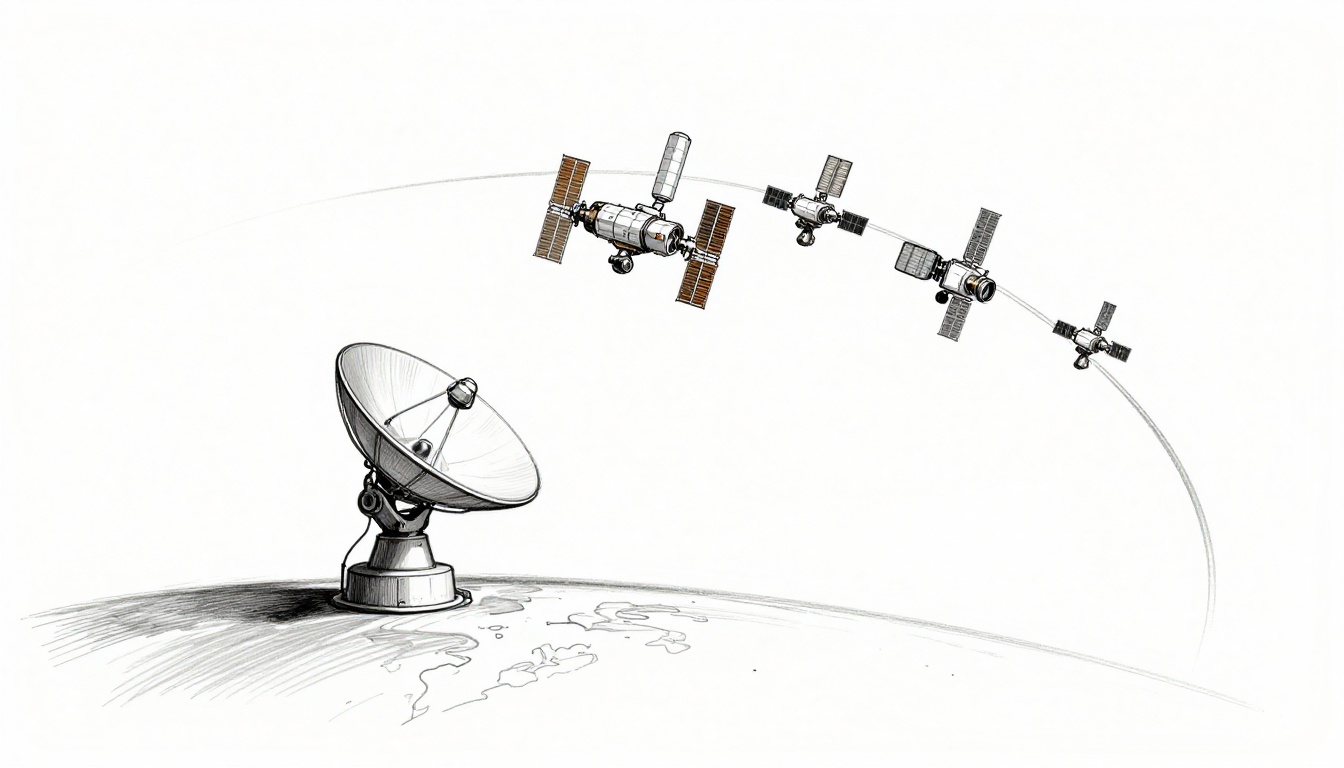
A satellite can look peaceful from the ground. But in March 2026, about 14,000 active satellites are orbiting Earth, alongside a growing cloud of debris. Even small bits can be dangerous, because fast objects can hit like bullets at orbital speeds. That’s why maintain satellites in space is more than a repair job. It’s also a way to prevent service outages.
When engineers plan maintenance, they’re really protecting everyday life. GPS timing, TV feeds, and internet links all depend on satellites staying healthy. If one satellite drifts off target, gets damaged, or runs out of fuel, users notice fast.
So how do teams keep satellites running? The answer comes in four parts: satellite ground control, smart onboard systems, robotic servicing missions, and careful end-of-life deorbiting. Next, you’ll see how each piece helps keep the space “highway” from getting clogged.
Tracking Every Move from Earth: The Power of Ground Control
Before anyone touches a satellite, they must know exactly where it is. That’s the job of satellite ground control. Teams use radars, telescopes, and other sensors to watch satellites and nearby debris. They track objects around the clock, then update each satellite’s orbit math.
Why so intense? Because collision risk often starts as a tiny change. A small orbit shift can shrink the gap between two objects. Many conjunction warnings focus on debris over 10 cm, since those pieces can do major damage.
When teams see a risky close approach, they don’t guess. They run collision avoidance calculations, using probabilities and updated tracking data. NESC Academy explains how collision avoidance moved from “distance only” to probability-based risk checks (which rely on uncertainty and timing). You can read the basics here: collision avoidance basics from NESC Academy.
If the risk is real, engineers can send a radio command to the spacecraft. Often, that command triggers a small orbit tweak. The move can happen fast, so the satellite slides to a safer path. That’s also a fuel problem, so engineers aim for the smallest burn that works. By doing this early, they can avoid urgent maneuvers later and help satellites last longer.
One big benefit is planning. When ground teams can predict changes in the orbit, they can schedule maintenance work around those realities. They can also coordinate with other operators to avoid messy surprises.
Meanwhile, some agencies are building tools that can automate parts of this process. ESA describes work on automated collision avoidance, including risk assessment and decision support that may even lead to direct maneuver orders. Learn more at ESA’s automated collision avoidance work.
24/7 Radar Surveillance and Collision Alerts
Think of radar tracking like sports officiating. You want nonstop attention, clear signals, and fast decisions. Ground systems continually measure where objects are, then compare measurements with expected paths. As new data arrives, the “best estimate” of positions updates.
When uncertainty grows, the risk model also changes. For example, weather can affect tracking for some sensors, and timing errors add noise. Teams handle this by calculating probabilities instead of relying on one distance number.
If the probability crosses a threshold, a collision alert goes out. Then engineers review possible responses. In many cases, the answer is a small thruster firing called a conjunction maneuver. That decision depends on how much fuel remains and how close the object will pass.
Sending Life-Saving Commands via Radio Signals
Once engineers choose a maneuver, they must send the instruction. That process is called uplinking. First, ground control prepares a command set for the satellite computer. Next, the team checks timing, frequencies, and system status.
Then comes the actual transmit. The satellite receives the radio signal, checks that it’s valid, and loads it into its onboard plan. After that, the spacecraft executes the burn using its thrusters.
Here’s the key idea: uplinking is not “push a button and hope.” Engineers design commands with guardrails. If the satellite’s condition looks off, it might delay the burn or use a safe mode plan.
Also, fuel matters. Small changes can cost less fuel than late, larger fixes. So teams try to act early, when the maneuver amount stays modest.
Built-In Brains and Thrusters: Onboard Systems at Work
Ground control watches and decides. But many satellite “maintenance” tasks happen onboard, without asking Earth every time. That’s why onboard engineering matters so much. Computers, sensors, and thrusters work together to keep the satellite in a usable state.
Modern satellites carry flight software that monitors health. It checks power levels, looks at temperatures, reads gyros and star trackers, and watches for subsystem faults. If something drifts out of limits, the satellite can trigger a recovery action.
Thrusters handle the physical side. They provide tiny pushes that counter problems like gravity variations and atmospheric drag. That’s especially important in low Earth orbit, where drag can act like constant air friction. In higher orbits, drag is less, but station-keeping still matters due to perturbations.
Engineers also plan fuel budgets as part of the design. The goal is simple: use fuel for the most important jobs first. Automatic fixes take some of the load off ground teams, too.
In addition, the communications chain can improve operations. For example, laser links can raise data rates between satellites and ground stations. That can help operators receive telemetry faster after a potential fault. Faster feedback means quicker maintenance decisions.
This kind of onboard satellite maintenance often looks boring on paper. In space, it’s what keeps the satellite alive.
Station-Keeping Maneuvers to Stay on Track
Even when a satellite is “in the right orbit,” it doesn’t stay perfect. Forces keep pulling it off target. In geostationary orbits, engineers fight slow drift over time. In other orbits, drag and gravity effects build up changes.
Station-keeping maneuvers use thrusters for small burns. These burns adjust velocity just enough to restore the desired orbit. Because changes are gradual, the maneuvers can be planned years ahead.
If you want a technical view, NASA has detailed work on station-keeping and related management for GOES-R. This PDF is a good example of how engineers think about thruster control and orbit upkeep: GOES-R stationkeeping and momentum management. For a simpler starting point, Wikipedia’s overview also explains the core idea behind station-keeping: orbital station-keeping.
In crowded orbital regions, station-keeping gets even more careful. A satellite might need to hold position with other assets nearby. That’s where small errors become big headaches for operators.
Automatic Fixes for Everyday Orbit Challenges
Space has routines. Gravity doesn’t switch off. Sunlight pressure nudges spacecraft. Earth’s shape and higher atmosphere variations can shift the orbit. Meanwhile, equipment can age, and software can hit odd states.
Onboard systems handle many “everyday” problems. For instance, computers can detect a thruster performance drop. If it happens, the system can adjust control parameters for the next burn. Sensors can also detect attitude drift, then run a control loop to point antennas back at Earth.
Also, satellites often run fault protection. If a component fails, the spacecraft can reroute power, turn off a risky load, or switch to a backup mode. In many designs, recovery is automatic, because waiting for a ground response may be too slow.
This approach can extend life because it reduces time spent in degraded operation. Less time in trouble also means fewer urgent repairs later.
Robot Rescuers in Action: Servicing Missions That Revive Satellites
Sometimes the best maintenance isn’t a software update. It’s a physical repair. That’s where robot servicing missions come in. A robotic vehicle can visit a target satellite, inspect it, and either fix parts or add life-extending hardware.
This is especially useful for geosynchronous satellites. In that orbit, a satellite can drift slowly over years. It can also run out of fuel for station-keeping. Once fuel is gone, the satellite can’t maintain its slot. Then the owner has to decide between replacement or extension.
One well-known direction in 2026 involves DARPA’s robotic servicing effort, which uses Northrop Grumman’s Mission Robotic Vehicle (MRV). Public updates describe an MRV robot built with robotic arms and the ability to attach “mission extension” propulsion packs called Mission Extension Pods.
According to realtime reporting, DARPA plans to launch a robot in 2026 to repair and refuel older satellites around 22,000 miles above Earth. The MRV can attach fuel packs, reposition satellites, inspect broken parts with cameras, and send back detailed images to operators. See the key program detail here: DARPA RSGS robotic repair mission overview.
This matters because physical servicing can keep satellites useful longer. It can also reduce the need to launch new satellites just to replace aging ones.
Grabbing and Refueling Old Satellites
A lot of servicing sounds like science fiction. But the core tasks follow familiar steps.
First, the robot approaches carefully. It uses cameras and sensors to identify key points on the target satellite. Next, it uses robotic arms to latch onto handholds or docking interfaces. Then it connects hardware that delivers extra propulsion.
For the MRV concept, the big win is fuel extension. Mission Extension Pods act like add-on propulsion modules. They give a satellite time to keep doing its job in orbit.
In short, refueling in space is like adding spare hours to an aging engine.
Repairing Stuck Panels and Antennas Up Close
Not every problem is fuel. Some satellites have mechanical issues, like a panel that won’t move or a sensor that doesn’t point correctly. Others suffer damage from impacts or wear.
Robotic servicing can help because it puts eyes right on the problem. With cameras and close approach tools, engineers can inspect damage without guessing. Then the robot can tighten, swap, or adjust parts if the design allows it.
Even when a repair is partial, it can return a satellite to stable operations. That’s often the difference between “still useful” and “mission ended early.”
Real-World Wins: DARPA and ISRO Examples
In 2026, DARPA RSGS is one of the clearest paths for on-orbit repair and refueling. The MRV robot concept targets geosynchronous satellites that need extra life, rather than waiting for a complete rebuild on Earth.
A related theme is the shift from “launch and forget” to “maintain and extend.” That shift shows up in mission planning too. Instead of designing for only one lifetime, operators now think about servicing access points, docking features, and repair interfaces.
That said, not every headline is easy to verify from public sources. For example, searches referenced an “ISRO Spinx” servicing mission name, but I did not find clear 2026 program details tied to that specific label in the sources reviewed. Still, the broader direction is real: multiple space agencies and commercial groups are working on technologies that make servicing more practical.
The practical goal is simple: keep satellites functioning longer, without creating more debris.
The Responsible Finish: Deorbiting to Clear Space Highways
Maintenance does not stop when the satellite runs out of fuel for station-keeping. Engineers also plan how a satellite leaves orbit. This final step protects other satellites and helps reduce future debris.
Deorbiting depends on the orbit type. In low Earth orbit, the satellite may naturally reenter faster if it has higher drag properties. In higher orbits, natural decay can take decades or more. For those cases, operators plan a powered end-of-life disposal method.
One well-known approach is ESA’s “Design for Demise,” which pushes spacecraft designers to make satellites break up and burn up safely during re-entry. That reduces the chance of large surviving fragments.
These end-of-life choices connect back to maintenance full-cycle thinking. A satellite that’s maintained well might live longer, but it still must retire responsibly. Likewise, a satellite that’s not maintained can fail in a way that leaves it drifting as debris.
A major trend is better end-of-life planning across the industry. Many operators also aim for “zero debris” thinking. Another trend is moving some missions toward VLEO, very low Earth orbit. In VLEO, higher atmospheric drag can cause faster orbit decay. In plain terms, the orbit can help clear the satellite sooner after mission end.
This is why “satellite deorbiting practices” are part of the maintenance story, not an afterthought.
Following Global Rules for Safe Re-Entry
Different regions and agencies follow different policy details, but the safety principle stays similar. Operators track mission end-of-life status. They avoid leaving dead satellites in long-lived orbits. They also plan disposal burns so the satellite can re-enter without lingering as a stable object.
Collision avoidance work also connects here. When engineers keep orbits safer during operations, they reduce the chances of breakup events. Then the deorbit plan helps prevent leftover debris from multiplying.
Emerging Trends in Debris-Free Orbits
Robots can reduce the need to replace satellites. But even serviced satellites still age, so the end game matters.
In addition, more constellations means more launch traffic. That adds pressure to prevent “collision chains,” where one breakup creates more objects. Better tracking, better collision avoidance, and responsible disposal all work together.
Robotic removal efforts are also growing. The idea is to remove spent objects before they fragment. Still, the logistics are complex and expensive. So for now, the most reliable improvements often come from earlier engineering choices, such as longer life designs and cleaner disposal planning.
Conclusion: Engineering Maintenance Across the Full Life of a Satellite
So, how do engineers maintain satellites in space? They combine satellite ground control, onboard smarts, robotic servicing, and a responsible deorbit plan. Ground teams track every move and send maneuver commands when needed. Onboard computers handle routine fixes and fault recovery. Robots can then extend the lives of older spacecraft through refueling and close repairs.
Then comes the final test: how the satellite ends its mission. Safe re-entry planning helps protect the next generation of missions, especially as the number of active satellites keeps rising.
If you’re excited about space, here’s a question worth thinking about. Would you rather see more robots for repairs, or more design changes to reduce the need for servicing? Share your take, and keep an eye on how engineers keep maintain satellites in space practical as orbit traffic grows.