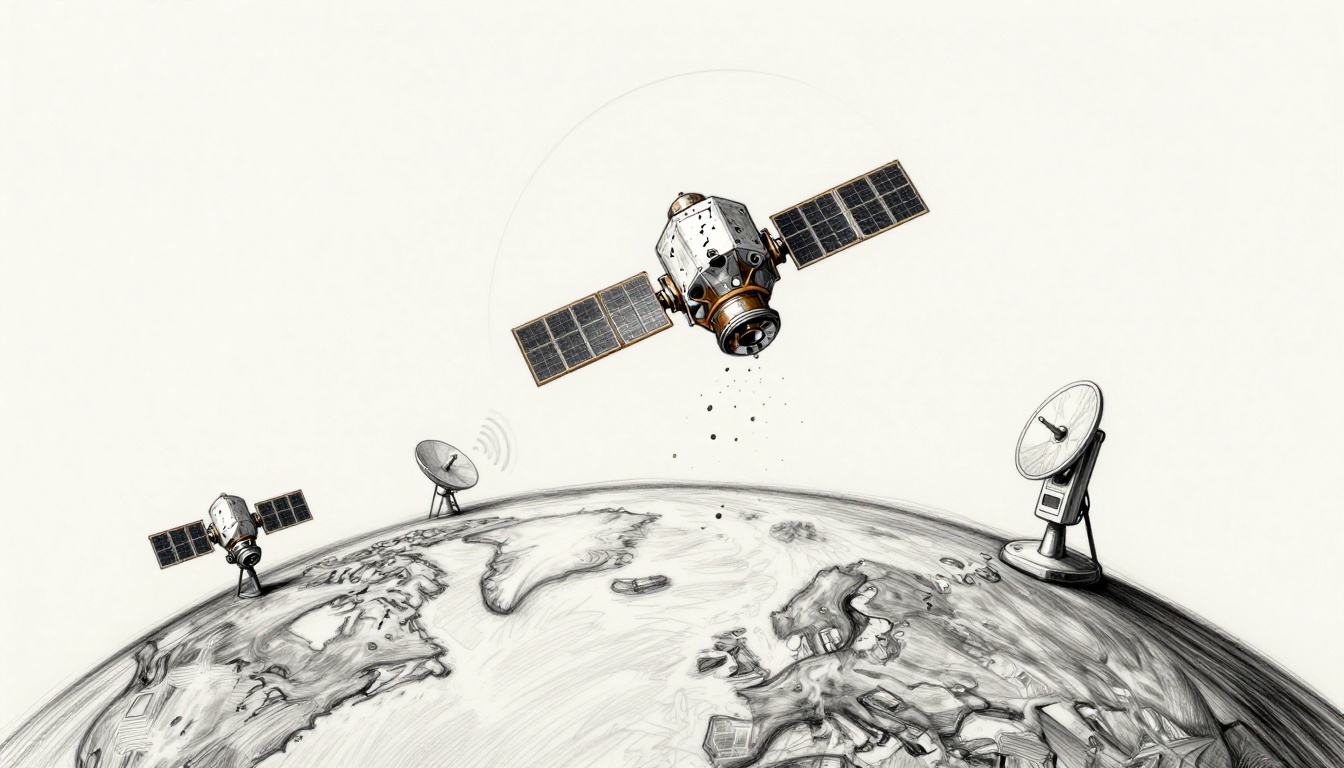
Your GPS can go blank mid-trip, your TV can cut out during the big game, or your weather app can miss the next storm. That feels like a software issue, but often it starts with a satellite failure far above you. Satellites act like space-based “infrastructure,” beaming signals for navigation, communications, Earth observation, timing, and internet access in remote areas.
Right now, space holds about 14,000 active satellites (as of March 2026). That’s a lot, but it also means failures can happen. Satellites also have short lifetimes compared to their orbit, so parts wear out and orbits shift over time.
When a satellite stops working, the impact can be quiet and local, or loud and global. Services may pause, degrade, or switch over to backup systems. Meanwhile, the dead spacecraft can become debris, which raises the risk for every other satellite sharing the same space.
In the sections below, you’ll see what actually causes satellite failures, what goes wrong inside a “dead” satellite, how outages ripple into real services, and what teams do to shut down missions safely. You’ll also learn why space junk matters, even when it never makes the news.
Why Satellites Fail After Years in Orbit
Satellites don’t last forever. Most are built for a set mission life, often 5 to 15 years. After that, aging parts and limited fuel can turn a working spacecraft into a silent one.
Also, space is getting busier. Beyond current satellites, companies have proposed about 1.23 million more missions in different stages of development. More launches mean more operational pressure, more crowded orbits, and more chances for trouble.
Here are the most common reasons a satellite fails, and why they’re often predictable.
Running Out of Fuel or Power
Think of a satellite like a car that needs both gas and electricity. The “gas” is fuel for small thrusters that keep it aimed at Earth and keep its orbit stable. The “electricity” comes from onboard power systems, usually solar panels plus batteries.
Over time, fuel gets used for station-keeping (staying in the right place) and for momentum control (staying pointed correctly). Batteries also lose capacity as charge cycles add up. Eventually, the satellite can’t maintain its orientation or comms link.
Some failures start with power stress. For example, unusual electrical activity in orbit can contribute to sudden problems, and researchers have studied how these effects can relate to failures during harsh conditions. For background on this type of issue, see how electrical discharges link to spacecraft failures.
If you want a broader view of the technical side, IEEE summaries cover common failure modes tied to power systems, including how issues cascade when energy management goes wrong. A starting point is causes of power-related satellite failures.
Smashing Into Space Junk
A collision sounds dramatic, but even a tiny object can cause huge damage. Space debris includes old satellites, rocket parts, and fragments from past breakups. Most collisions happen at speeds that feel unreal on Earth.
One of the clearest examples is the 2009 Iridium 33 and Kosmos 2251 collision. It occurred at about 26,000 mph. That speed turns a small impact into a catastrophic event.
The aftermath matters because collisions can create a cloud of fragments. One event can seed future close calls for years. For a clear breakdown of what that kind of collision does to the debris environment, see how the Iridium-Cosmos crash increased space debris.
Also, agencies analyzed the collision as a sign of how severe fragmentation can get. NASA technical reporting discusses how many debris pieces resulted and how long they may reenter. You can read NASA’s report on the Iridium 33 and Cosmos 2251 collision.
In short, a collision is like a high-speed car crash in space. But instead of exchanging dents, it can create thousands of bullets that keep flying.
Damage from Solar Storms and Space Weather
Space weather can also knock satellites offline. Solar flares and coronal mass ejections send bursts of energy toward Earth. When charged particles and strong radiation arrive, they can disturb electronics, raise charging on surfaces, and harm sensitive circuits.
If your satellite’s components are already stressed, space weather can push them over the edge. Even if the spacecraft survives, its operators may have to reduce power use or change operating modes to keep it stable.
This links back to the “aging car” idea. Fuel and power limits mean a satellite can have less margin to handle unexpected jolts. Solar events are less frequent than fuel burn or wear, but they can still cause serious outages. And if a dead satellite is left tumbling or operating unpredictably, it can also raise the odds of further problems.
The Immediate Chaos Inside a Dead Satellite
When a satellite stops working, it usually doesn’t “turn off” like a light switch. Instead, things break in a chain, starting with systems that can’t talk, can’t point, or can’t power up again.
To picture it, imagine a weather balloon that loses its radio and drifts away. Then multiply that by years of orbital motion. The longer it stays in space, the more it becomes hard to control.
Here’s what typically happens next.
Losing Contact and Control
First, operators may notice the satellite is not responding. That can look like no downlink signal, missed telemetry, or delays in communication that never recover.
Then attitude control can fail. Many satellites use reaction wheels, thrusters, or control moment gyros to point their antennas and instruments. If control systems fail, the spacecraft may start tumbling.
Once a satellite tumbles, it can lose alignment with ground antennas. As a result, operators might struggle to regain a stable link. Even if the hardware still has power, the communications geometry may make contact nearly impossible.
Operators also monitor orbit and health. If thruster control fails, the satellite can drift out of its intended path. Then it becomes harder to avoid other objects safely. In other words, “no contact” can quickly become “no management.”
Backup Systems Jump In
Some satellite networks include backups or extra units. For example, constellations can carry spare capacity so users still get service when one unit fails.
However, backups do not make problems disappear. People might see short gaps, slower speeds, or errors before systems re-route traffic. In navigation or timing services, the issue can show up as reduced accuracy, longer fix times, or temporary routing changes.
If the service depends on a single “critical” satellite, outages can last longer. That’s why the next section matters: the effects are often small locally, but they can be big when the satellite supports mission-critical functions.
Real-Life Disruptions from Satellite Blackouts
Satellite outages rarely stay hidden. They show up in everyday tools, plus industries that rely on precise timing and location.
The ripple effect can vary by service type. A casual internet slowdown is one thing. A navigation glitch for shipping or aviation is another.
Ever wonder why your nav app glitches during a trip? Often, it’s not “the app.” It can be the satellite side losing signal quality or coverage.
GPS Navigation Gone Wrong
GPS depends on satellites that broadcast position signals. If one or more satellites go offline, receivers can still work, but accuracy can drop.
For drivers, that might mean a route update that feels late. For trucking and shipping, it can mean slower planning and rerouting. For aviation, even small accuracy shifts can trigger extra checks.
In maritime operations, location errors can also affect safe docking plans and route tracking. Meanwhile, timing signals affect more than maps. They influence how systems synchronize operations across networks.
TV, Internet, and Phone Service Cuts
Many direct-to-home TV systems rely on satellites as their broadcast backbone. If a satellite stops transmitting, viewers can lose channels until ground networks redirect service.
Phone and internet connectivity can also suffer, especially in remote regions. Some areas depend on satellites because fiber or cable lines simply don’t reach. In those cases, a blackout can turn “offline for a moment” into “offline for hours.”
Constellations can reduce the blast radius because other satellites cover the region. Still, network routing takes time, and users may notice it first.
Weather Forecasts and Emergency Warnings Fail
Weather services use satellites to observe clouds, storms, ocean conditions, and atmospheric patterns. If data drops, forecast models can lose inputs that help predict timing and intensity.
That matters for disaster response. Emergency managers depend on timely updates for flood risk, wind damage, and storm surge timing. Farmers also rely on accurate forecasts for planting and irrigation choices.
Even when forecasts remain usable, missing data can reduce confidence. In fast-moving events, that uncertainty can cost time.
How Teams Handle and Dispose of Dead Satellites
When a satellite fails, the work doesn’t end with “it’s dead.” Operators and mission teams try to manage two goals: prevent further harm and reduce debris risk.
They usually start by tracking the satellite’s new behavior. Then they decide whether it can be safely stabilized, passivated, or deorbited. The plan depends heavily on altitude.
Here’s what that process looks like in practice.
Tracking and Safely Shutting Down
If operators still have limited control or partial power, they try to stop the worst hazards. A key step is passivation, which reduces explosion risk.
Satellites often carry residual fuel and high-energy components. If those components remain active, the satellite can become unstable. Passivation aims to remove stored energy safely. It also helps limit the chance of an explosion that would create more fragments.
Teams rely on ground stations, radar, and sensor data to understand the satellite’s orbit and attitude. In some cases, they can raise or adjust altitude. In others, they focus on safe energy removal and long-term tracking.
Natural Burn-Up or Graveyard Orbits
Where a satellite ends up depends on what kind of orbit it occupies.
In lower Earth orbit (LEO), many dead satellites eventually burn up as they encounter higher drag. Solar activity can increase drag, which can shorten reentry time. In other words, the satellite may fall back after months or years.
In higher or more stable orbits, drag is weaker. Satellites may not naturally reenter soon. For those orbits, operators often move retired satellites to a “graveyard” region. This keeps dead spacecraft away from working satellites that still need the original orbit path.
Climate can add pressure here. As the upper atmosphere changes, drag patterns can shift. That can affect how long objects linger. Even so, teams can’t rely on natural decay alone for risk control.
The Scary Rise of Space Junk from Failed Satellites
When a satellite dies, the risk doesn’t stop at loss of service. The bigger, longer-term fear is that dead spacecraft can break apart and multiply debris.
In early 2026, agencies track about 44,870 to 48,000 large debris objects (over 10 cm). That includes rocket fragments and pieces from older breakups. Smaller items are far more common, but harder to track.
At high speeds, even small pieces can damage active satellites. So debris growth can turn into a long-term upward spiral.
What Is Kessler Syndrome and Why It Terrifies Experts
Kessler Syndrome describes a chain reaction. One collision creates lots of new debris. Those pieces then collide with other objects. Over time, orbits become more and more unusable.
It’s like a cosmic car pileup that keeps generating more cars. When those cars keep crashing, clearing the road becomes harder.
If you want a simple reference on the concept and the history behind it, see Kessler syndrome. The real concern is not one collision. The concern is how repeated collisions can make future collisions more likely.
Debris also costs money. Modeling has estimated the space industry could face $25.8 to $42.3 billion in costs over the next decade, driven by the cost of dodging, added shielding, insurance increases, and lost assets.
How Mega-Constellations Like Starlink Make It Worse
Mega-constellations change the math. They launch many satellites, often on short timelines, and they operate across wide regions. That increases failure odds because there are more spacecraft in orbit at once.
More launches also mean more traffic management. Satellites track and avoid debris, and they sometimes need to dodge other satellites too. If one unit fails and stops cooperating, the system may rely on others to keep coverage.
Constellations help people connect, especially where terrestrial networks are limited. At the same time, they raise the need for careful debris tracking and fast response when something stops working.
In the long run, space sustainability depends on better shutdown practices, improved collision avoidance, and reliable deorbit systems. Otherwise, every failure becomes a bigger problem for everyone.
Conclusion
When a satellite stops working, the effects go beyond a blank screen. First, the spacecraft loses power, control, or communication. Then the service can pause, degrade, or switch to backups.
Over time, the biggest risk comes from what happens next. A dead satellite can contribute to debris, and debris can raise the odds of future collisions. That’s why teams focus so hard on tracking, passivation, and responsible end-of-mission plans.
Space is only getting busier, with tens of thousands of satellites already in orbit and far more planned. That makes one idea stand out: satellite failures are not isolated events. They shape safety, service reliability, and how long usable orbits stay available.
If you rely on satellite services, share this with someone who doesn’t realize how close the “space layer” is to daily life. What’s one outage you remember that made you think, “Now I get it”?