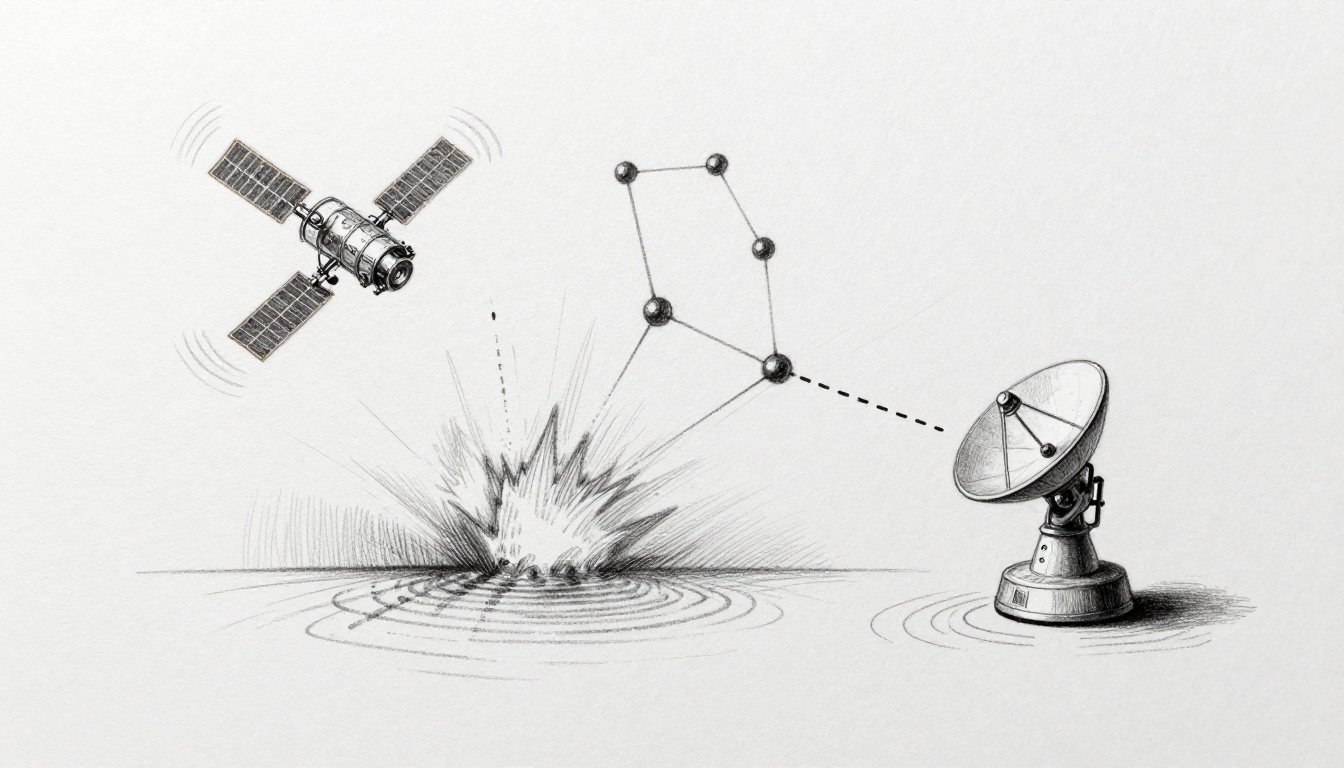
You can lose service or trust the wrong location in minutes, even when nothing seems “broken” on the ground. In 2025, Starlink saw two major outages (one from a software error on July 24, and one from a space weather storm on September 14 to 15), and people on multiple continents reported sudden drops in connectivity. Meanwhile, when storms hit, GPS can get it wrong too, and navigation apps and weather forecasts can wobble fast.
So what’s behind these failures? A satellite system uses objects in orbit to send signals for communications, navigation, and imaging. Those signals have to pass through space and Earth’s upper atmosphere, while the satellite hardware has to survive extreme heat swings, radiation, and fast-changing conditions.
Here’s the big pressure point. From 2024 to 2026, space weather showed up as drag spikes, radio link dropouts, and ionosphere effects that disrupt GNSS signals. At the same time, orbital crowding keeps pushing satellites into busy lanes, which raises the stakes for thermal balance, power margins, and safe maneuvers.
Because of all that, common technical problems tend to hit the same subsystems hardest: power, communications, thermal control, attitude control, radiation, and propulsion. Next, we’ll break down what those failures look like in real life, with clear examples from recent events.
Power Drains That Leave Satellites in the Dark
Space weather can turn satellite power like a car battery in stop-and-go traffic. You still “have power,” but every extra moment of load pulls the level lower. In low Earth orbit (LEO), that pressure often spikes during major solar storms, because the Sun’s activity heats the upper atmosphere and forces satellites to spend power just to stay safe.
Real-World Hits from Recent Solar Storms
In May 2024’s Gannon Storm and January 2026’s geomagnetic storm period, operators saw the same chain reaction: heated atmosphere, boosted drag, forced thruster use, and batteries that can’t catch up. LEO constellations like Starlink take the hardest hit because their orbits sit closest to the denser upper air.
The key power drain starts upstream. When the storm hits, the atmosphere expands and gets “thicker,” so satellites meet more air. That drag pushes them downward faster, so they must correct their orbit more often. Every maneuver and every control-system workload draws from the battery during the “no sunlight” parts of the orbit.
Here is what that looks like in practice:
- May 2024 (Gannon Storm), LEO safe modes and fuel burn
- Operators put over half of active LEO satellites into safe mode to protect hardware during the worst conditions.
- Starlink performed a large number of emergency maneuvers to maintain relative positions, which means more thruster time and more power draw.
- As one satellite re-entered early, it shows how quickly extra drag can shrink margins, especially at lower altitudes. For a deeper technical summary, see May 2024 Gannon Storm impacts on LEO spacecraft.
- January 2026, strong storm forcing protective behavior
- Reports describe severe flare and CME-driven effects, which can raise drag and disrupt spacecraft operations.
- In some cases, satellites that were newly launched entered protective modes and never fully recovered, because the storm hit before they could stabilize operations. For context on the flare timing, see X-class flare and CME racing toward Earth.
Now imagine your internet link as a dimmer switch. When a satellite drops into safe mode or spends more power on attitude and orbit keeping, service can still “work,” but not at full speed. Ever wonder why your connection lagged during a storm window? That timing lines up with higher power strain, reduced stability, and more frequent control actions.
The scary part is the risk of total power loss. Once batteries dip too low, recovery becomes harder, not easier.
Finally, this is not only a short-term nuisance. Extra maneuvers eat fuel, and extra heating plus power cycling can shorten useful lifespans. Over time, satellites that keep spending margin to survive storms have less margin left for years of normal operations.
Communication Breakdowns Silencing Satellite Signals
When satellite signals fail, it rarely looks like a total blackout on day one. Instead, it feels like the world grew a small delay, then a bigger one. In crowded space, that starts to happen for two big reasons: too many transmissions in the same time and place, and space weather that weakens links. Put those together, and the receiver can lose the clean “thread” it needs to lock onto a signal.
Also, unlike air traffic control, there is no global, one-size-fits-all rule that keeps every satellite perfectly spaced. Different systems share spectrum using agreements, filters, and power limits, but each operator also has its own hardware and rules. So interference issues can still creep in, even when everyone follows the plan.
Frequency Clashes in a Crowded Sky
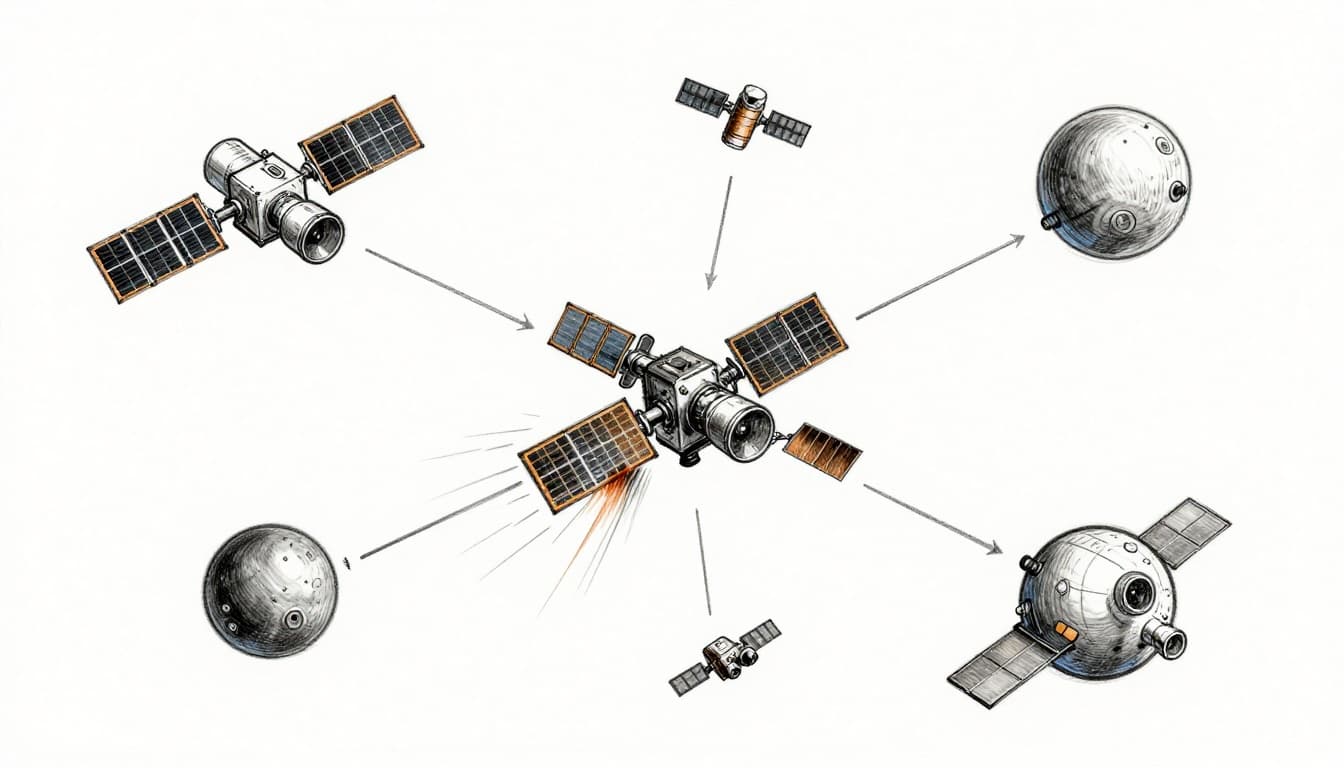
With about 15,000 active satellites in orbit, plus many more planned, radio links now compete more often. Each satellite beams toward user terminals on Earth, and those signals also bounce off the environment in different ways. As the number of transmitters grows, so does the chance that a receiver sees too much “background” energy at the same moment.
Here’s the key idea: it’s not always about signals being on the exact same frequency. It can be about close-by spectrum, side lobes from antennas, or unwanted emissions that spill into protected bands. Think of it like a room where multiple people talk at once. You don’t need identical voices to make conversation hard. You just need enough overlap.
In practice, companies like SpaceX operate mega-constellations with thousands of satellites, and that scale changes the odds. Recent research and reporting have flagged cases where Starlink satellites create unintended radio interference that can affect sensitive science instruments, even if the main service link follows expected operating rules. For a detailed example of the emissions concern, see Starlink emissions and radio astronomy effects.
At the same time, other disputes show up as policy fights. Spectrum sharing for LEO vs legacy geostationary networks involves rules that were built decades ago. As new systems add capacity, old limits can feel too tight or too loose, depending on who you ask. One example is ongoing controversy around FCC spectrum sharing and power limits, such as FCC spectrum sharing rules debate.
Now add storms and things get worse. Space weather can increase noise in receivers and disturb timing and tracking. When that happens, a weak or messy signal can fail fast. The receiver might drop the link, re-lock, or fall back to a lower-rate mode.
Finally, consider how outages can look in daily life. If you rely on satcom for backhaul, shipping, or direct-to-device service, interference and link instability can mean:
- a delayed message,
- a video that won’t load,
- or a map that takes a few extra seconds to update.
And when GPS needs “loss of lock” recovery, position updates can wobble too. In short, crowded signals and storm noise both push receivers past their tolerance, so the system pauses, corrects, and tries again.
The surprising part is timing: many failures look like “random drops,” but they often happen during the same busy windows, when links are already under stress.
For more on how geomagnetic storms reach severe levels, check NOAA’s G4 storm updates for 2026.
Thermal Headaches Cooking Satellite Parts
When people picture a satellite problem, they think of antennas or software. Yet heat can quietly bully the whole bus. In space, temperature control works like home insulation plus a thermostat, but the “weather” changes fast. During geomagnetic storms, the upper air heats up, and satellites in low Earth orbit take the hit through drag and then thermal stress.
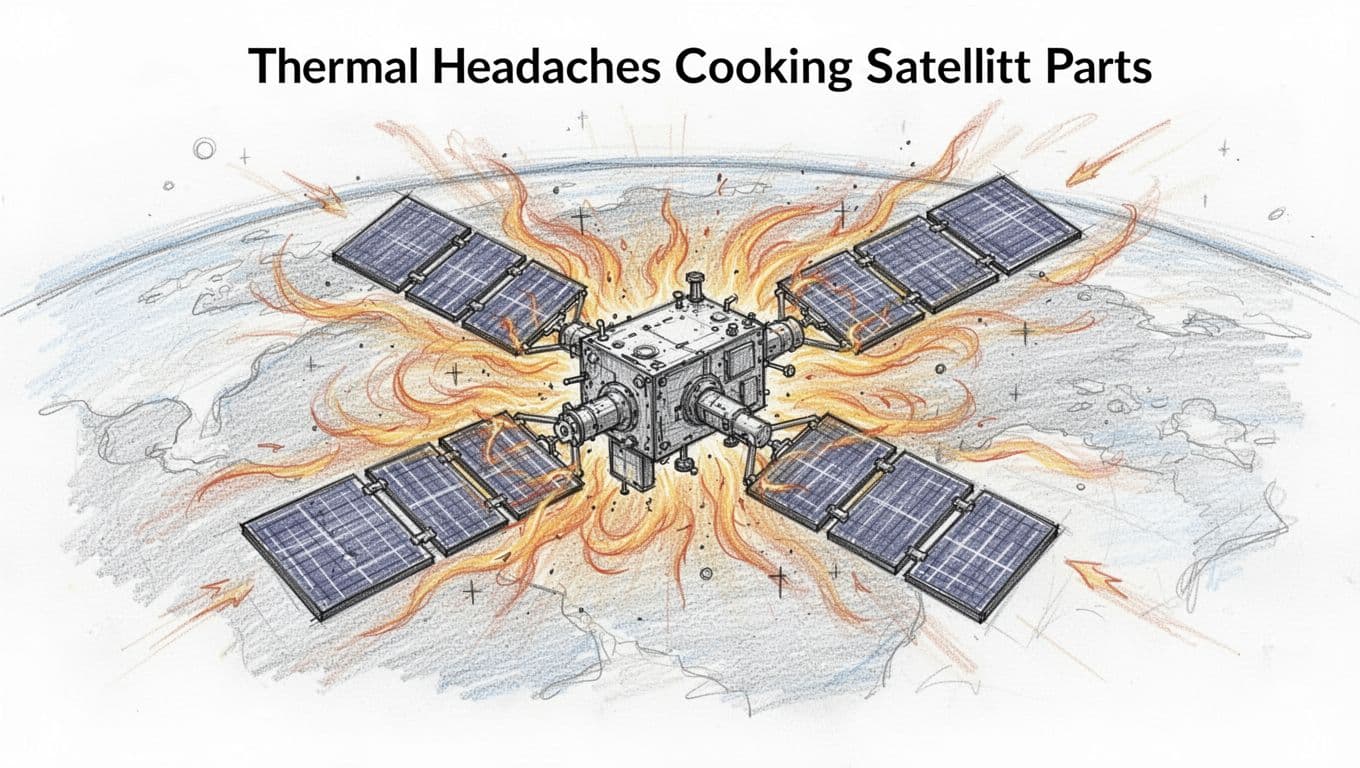
It can feel like a car overheating in gridlock. The engine still runs, but the system gets trapped in a heat loop. For satellites, the loop starts when storm energy heats the thermosphere, which expands and swells around the vehicle. As a result, air gets denser where it used to be thinner.
Why geomagnetic storms spike drag at 210 to 300 km
In low Earth orbit, the drag jump matters most around 210 to 300 km. Storm-driven heating expands that layer upward, so the satellite collides with more air molecules than planned. Even a small density change can cause a big drag increase, which forces more orbit corrections and attitude holding.
That matters for thermal control, because more maneuvers mean more thruster activity and more internal power cycling. Also, frictional heating and altered heat flow change how the satellite skin and radiator surfaces behave. Over a few orbits, temperature can swing harder than the thermal model expects.
NOAA tracks this broader risk in its satellite drag overview, which helps explain why storm timing can line up with service instability.
What “thermal control” failures look like in real hardware
Thermal systems don’t usually fail like a light switch. Instead, you get symptoms that build up:
- Radiator stress: cooling surfaces can work too hard, then recover unevenly.
- Insulation gaps: hot spots form where heat soaks deeper than expected.
- Heater cycling: parts flip between too cold and too warm, which strains margins.
During the May 2024 Gannon geomagnetic storm, research and mission reports tied the worst operational impacts to a sharp thermosphere response and increased orbital decay, which then cascades into thermal strain. For a closer look at that storm’s thermospheric effects, see Thermospheric Response and Operational Impacts during the 2024 Gannon Geomagnetic Storm.
In short, storms do not just add heat. They change the whole heat-and-drag balance, and that’s how “cooking satellite parts” starts.
Attitude Control Woes: Satellites Losing Their Way
When a satellite loses its sense of “which way is up,” everything gets harder fast. Attitude control is the steering system, and in strong space weather from 2024 to 2026, storms can disturb the forces a satellite relies on. As a result, you can see position fixes fail, safe modes trigger, and operators scramble to regain control.
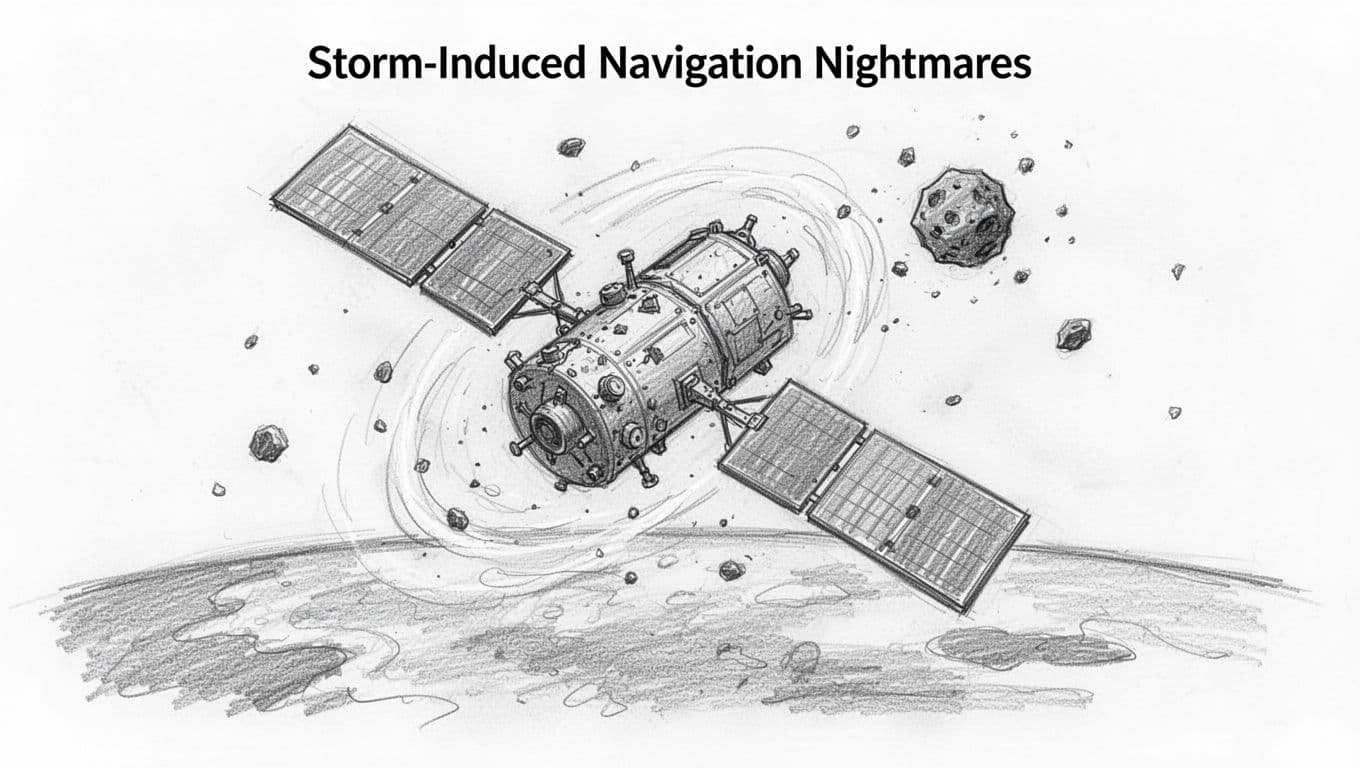
Storm-Induced Navigation Nightmares
Think of attitude control like a cyclist keeping balance on a windy road. Under normal conditions, the bike stays steady with small, expected corrections. During a major geomagnetic storm, the road gets lumpy. First, the atmosphere heats and expands, so drag changes. Then, that drag does not hit evenly. It creates extra torque, which nudges the spacecraft’s pointing off target.
Now pair that with navigation strain. Storms can disrupt GNSS signals through ionosphere changes, so the spacecraft struggles to keep a clean fix. When the satellite can’t confirm its orientation and location, its navigation filters start to disagree with themselves. In that moment, “being sure” costs time and power, so controllers often shift to safer behavior.
This is where safe modes matter. Satellites may enter a protective state to stabilize thermal limits, limit power use, and reduce workload while control solutions settle. However, safe mode can also slow down orbit maintenance and collision avoidance. For some missions, the system can spend more time recovering, then less time correcting the original drift.
Meanwhile, debris tracking gets messy. As orbits shift faster than expected, tracking logic can lose lock or lose accuracy. Operators then have to restart collision checks, like re-running the math after the numbers changed mid-calculation. In the worst cases, the satellite’s control loop can over-correct, leading to spins or persistent tilts. Without traffic control in space, teams may have to perform manual dodges.
The risk goes beyond inconvenience. With reduced pointing accuracy and late awareness of relative motion, satellites have less room to avoid close approaches. Research on past storm periods also shows how intense space weather can drive major orbital decay for LEO fleets, which then feeds into these control and tracking problems. For background, see Loss of 12 Starlink Satellites Due to Intense Space Weather.
Radiation Strikes Zapping Satellite Electronics
Radiation problems don’t always look dramatic. Often, the first sign is quiet, like an imaging window that suddenly goes dark. Then the satellite restarts, drops into protect mode, or loses a sensor for a while.
When people say “radiation strikes,” they usually mean high-energy particles hitting electronic parts. Protons are a common culprit during strong solar radiation storms. They can punch straight through shielding that looks thick to humans, then trigger faults inside computers, memory chips, and sensor electronics.
Lessons from Planet Labs and Weather Sats
A clear example came during the May 2024 Gannon geomagnetic event, when Planet Labs satellites (SkySat and SuperDove) entered a protective mode. The trigger in these cases is often single event upsets (SEUs), which are bit flips caused by a proton hit. That kind of glitch can be small, but it can still break control loops, corrupt data handling, or make the flight software behave like something is wrong. As a result, teams switch to safe behavior, reduce activity, and wait for the storm intensity to drop.
Now fast forward to January 2026, where the S4 solar radiation storm (strongest since 2003) hit Earth with fast protons. NOAA’s GOES-19 in geostationary orbit recorded the event at S4 levels, and operators saw sensor and electronics stress consistent with radiation effects during extreme proton flux. For a live event log and context, see NOAA’s S4 storm update.
Here’s the user-facing angle that matters most for imaging: protective actions can create imaging blackouts. When the system powers down or limits payload use, you lose revisit time, even if the bus still “works.”
And shielding has limits. Even with radiation-hardened parts, protection is not infinite. Manufacturers rate components for a certain dose and upset rate, then real storms add up. Over repeated events, cumulative radiation damage can shrink mission life, and some planning models estimate drops down to about five years under severe cumulative exposure.
Hardening reduces risk, but it cannot stop every fault during extreme proton events.
So when you see protect mode during a major storm, think of it like a smoke alarm. It triggers early to save the electronics, even though it costs you light for a bit.
Propulsion Crunch: Fuel Gone Too Soon
Once propulsion starts to feel urgent, you can watch a satellite’s “safety math” change in real time. Fuel becomes like cash in a wallet, and storms or close approaches are the surprise bills. When you spend extra, you still need to keep control, avoid debris, and maintain the right orbit for service.
In low Earth orbit, the pressure piles up fast. Drag can jump during geomagnetic storms, so satellites need more orbit-keeping burns. At the same time, there’s less room for error during conjunction planning, because crowded lanes raise the odds of near misses. That’s where the propulsion crunch begins, and why “no maneuver” can suddenly turn into a chain reaction.
Debris Dodges Speeding Up the End
Here’s the uncomfortable reality: close approaches in LEO are frequent, and they force constant decision-making. Current risk tracking shows a major collision could occur in about 3.0 days if satellites stopped avoidance maneuvers. Close approaches under 1 km happen roughly every 22 seconds across LEO megaconstellations, and about every 11 minutes in Starlink alone. Even if your system avoids the collision, every dodge still spends something.
Debris is a numbers game. As of March 2026, there are 50,000 pieces of debris 10 cm and larger in orbit, with over a million smaller objects that can still damage spacecraft at high speed. When those objects drift, their paths cross at awkward times. Then the avoidance logic kicks in, like swerving on a highway when you spot headlights too late.
Also, this is where “no maneuvers lead to chains” turns into a real mechanism. If operators skip avoidance for too long, relative motion keeps closing. A single avoided close approach reduces risk for that pass, but the longer you wait, the more options shrink. Fuel margin, attitude pointing limits, and power budgets all become constraints. After all, you can’t dodge forever with a single tank.
It can look like this:
- More drag means more re-positioning burns, even without debris.
- More conjunctions means more avoidance burns, even when you plan carefully.
- Batteries and safe modes squeeze operations, so burns may need to happen on short windows.
- Every burn changes geometry, which can increase future avoidance needs.
This pattern is why some analysts warn about Kessler syndrome risk, a chain of collisions that ramps debris faster over time. While it’s not guaranteed, the conditions are there, especially when traffic control remains limited across multiple operators.
To see how the pace has scaled, consider how often constellations must act. SpaceX reported that Starlink satellites performed huge maneuver counts in 2025, and it also planned thousands of satellite drops in 2026 to reduce collision risk. Coverage like Starlink collision avoidance maneuver counts in 2025 captures why the math becomes relentless at modern scale.
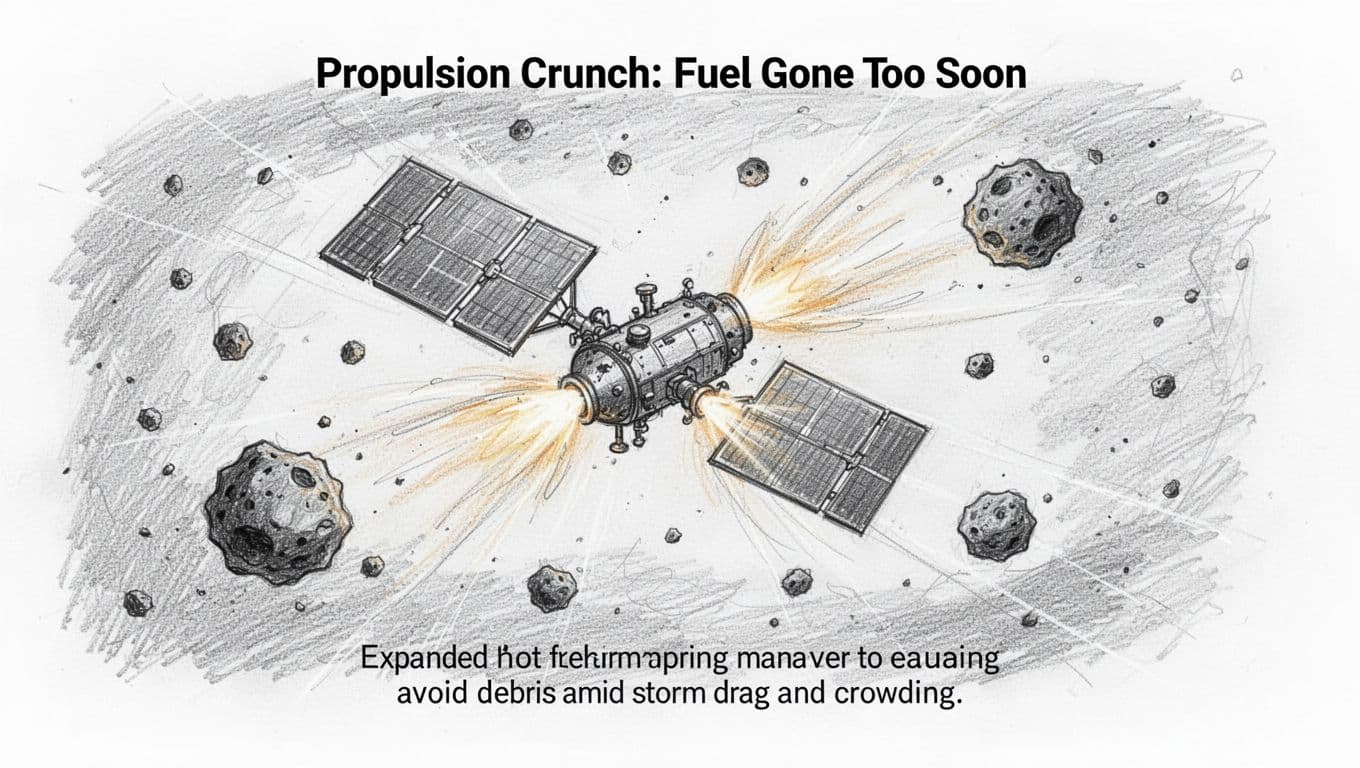
One last twist ties back to propulsion directly: if you lose options during a storm, you may spend fuel just to stay able to maneuver later. And if you can’t, your “end” comes faster than the team expected.
For background on why LEO feels so fragile as it gets more crowded, see low Earth orbit catastrophe risk analysis.
Conclusion
Common technical problems in satellite systems often trace back to two pressures. Space weather stresses the bus through power drain, link dropouts, thermal strain, attitude control errors, radiation faults, and extra propulsion needs. At the same time, orbital crowding raises the odds that small issues turn into service gaps, because satellites share busy orbits and limited margin.
Even when everything looks normal on the ground, storms can shift drag, heat, and radio noise fast. Then, the system responds with protective modes, re-locking signals, and extra maneuvers. That combination explains why outages can feel sudden, and why repeated events can wear down hardware over time.
The strongest next step is simple: stay current and act early. Follow space weather updates and operator notices, and support smart traffic management and spectrum rules so the fixes scale with growth. What change would help you most, better storm warnings, stronger shielding, or tighter space traffic control? Satellite tech still powers modern life, but it only stays reliable when we respect how hard orbit and storms can be.